Short answer: most people asking this do not need a 4WD. The East Coast, the Great Ocean Road and the Stuart Highway from Darwin to Adelaide are sealed the whole way, and a 2WD van from $49 a day does them fine. A 4WD earns its keep on the Gibb River Road, Cape York, Karijini’s gravel and the outback tracks. For those, pick a roof-top tent 4WD from $119 a day or a 4WD campervan with the bed and kitchen inside from $159 a day. One caveat: many rental companies do not allow beach or sand driving, so for K’gari (Fraser Island) the answer is a dedicated K’gari 4WD hire, not a campervan. Final prices depend on dates, depot and one-way fees; the free quote shows the real figure.
| Rig | Sleeps | From per day | Best for |
|---|---|---|---|
| 2-seater, 2-sleeper | 2 | $49 | Couples and solos on sealed roads, 1 to 4 weeks |
| Low-top campervan | 2 to 3 | $79 | Tight budgets, 2+ week coastal trips |
| Hi-top campervan | 2 to 3 | $95 | Longer trips, standing room, still 2WD |
| Motorhome | families | $175 | Comfort on sealed roads, NT touring on the highway |
| Roof-top tent 4WD | 2 | $119 | Couples wanting off-road access and a 60-second setup |
| 4WD campervan | 2 to 5 | $159 | Outback expeditions, Gibb River Road, Cape York, Karijini |
All prices are “from” rates for our quoted vehicles and move with season and depot.
Somewhere past the last roadhouse on the Gibb, the cutlery drawer starts playing the drums. Corrugations do that. Every bolt on the rig finds its own frequency, the red dust gets into the fridge seals, your phone has had no signal since breakfast, and then you crest a rise and the whole Kimberley is laid out in front of you like somebody spilled it. That is what a 4WD rental buys you. The question is if your trip actually goes there.
Do you actually need a 4WD?
Route by route, because the 4WD rate roughly doubles the daily cost and the fuel bill goes with it.
Sydney to Cairns, Brisbane to Cairns, Brisbane to Sydney. No. Sealed end to end, powered caravan parks, every famous stop on bitumen. Take the cheaper van and spend the difference on the reef. Our Sydney to Cairns, Brisbane to Cairns and Brisbane to Sydney pages are built around 2WD rigs for that reason. Weighing a van against a bus pass? That is covered in Campervan vs Bus Pass vs Tour.
Great Ocean Road, Melbourne to Adelaide, Tasmania. No. Sealed, scenic, and busy enough that you will want the smallest van you can sleep in for the car parks. See Melbourne to Adelaide and the Tasmania loop.
Darwin to Adelaide on the Stuart Highway. Still no, and this one surprises people. The Stuart is sealed the whole way, with roadhouses spaced along it, and Uluru, Kings Canyon and Katherine Gorge are all on bitumen. A hi-top does the whole Darwin to Adelaide run. The 4WD starts earning its money the moment you turn off: Kakadu’s 4WD-only tracks to Jim Jim and Twin Falls, the Mereenie Loop, the Oodnadatta Track. Highway plus national park roads, go 2WD. Those turn-offs, go 4WD. Same logic for Melbourne to Darwin.
Perth to Broome. Depends on Karijini. The coast road is sealed and a 2WD does Kalbarri, Shark Bay and Exmouth happily. But Karijini is the headline of the Perth to Broome run and its internal roads are gravel. Many rental companies ban 2WD vehicles from unsealed roads, so check your rental terms before planning a Karijini detour in a hi-top. A 4WD removes the question.
Gibb River Road. Yes, no debate. Roughly 660 kilometres between Derby and Kununurra, most of it unsealed, with creek crossings, gorges off side tracks, and corrugations that test every weld. This is the trip the 4WD campervan exists for. Dry season only: in the wet season, roughly November to April, many unsealed roads close, and the Gibb is usually one of them.
Cape York. Yes. The run to the Tip is a serious remote trip with river crossings and long unsealed stretches, and the same wet-season closures apply. Most rental companies restrict which tracks their vehicles can use up here, so read that list before you book.
Roof-top tent or 4WD camper?
Both get you down the same tracks. They differ in where you sleep and how much fuss it is.
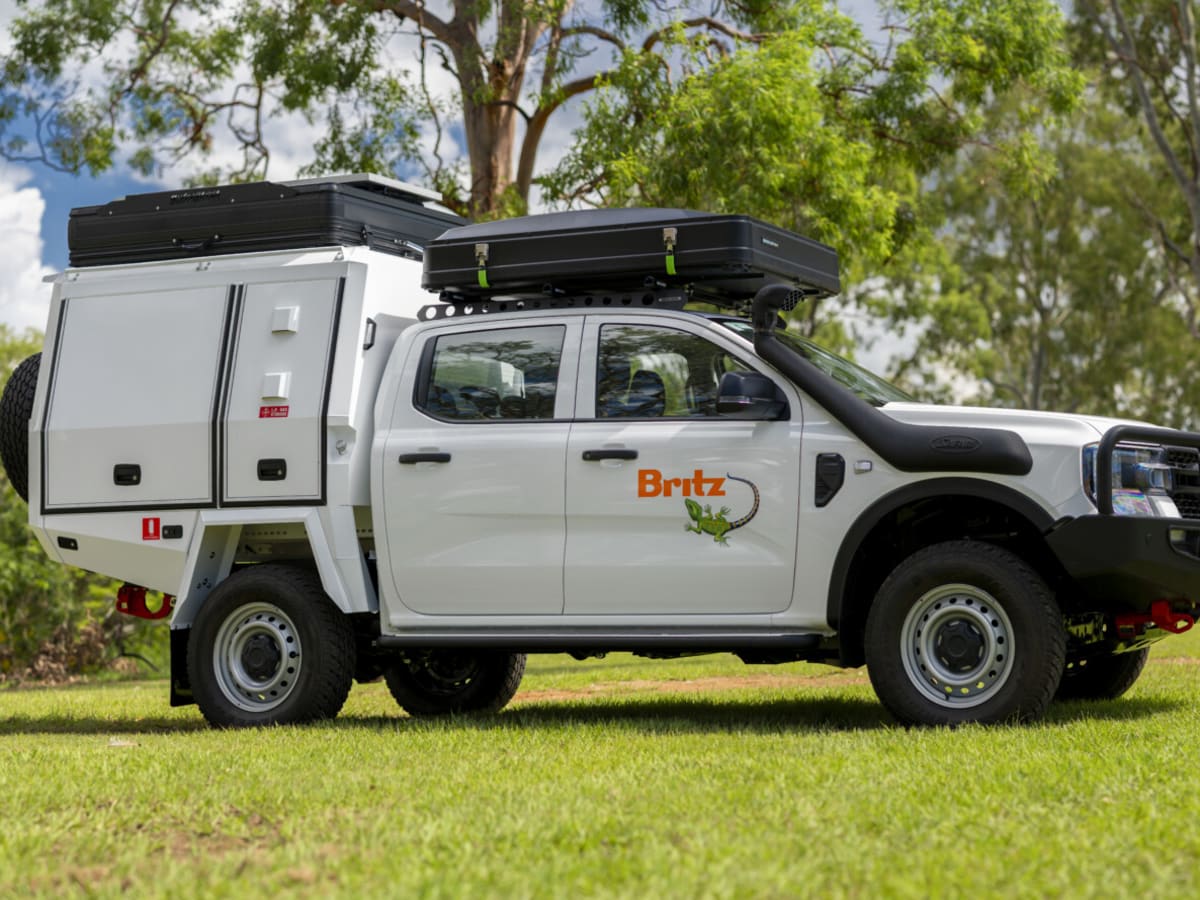
Roof-top tent, from $119 a day. An SUV with a fold-out tent on the roof. Setup takes about a minute, mattress and bedding included, kitchen kit, 12V fridge and basic recovery gear in the back. You sleep off the ground, which matters more once you have seen what walks past at night. Downsides: nowhere to stand up, no indoor cooking, a ladder to climb at 3am. Sleeps two. Pick it if you are a couple who likes being outside and moving camp most days.
4WD campervan, from $159 a day. A high-clearance 4WD with a camper conversion: pop-up roof, permanent bed, gas stove and sink inside, 12V/240V fridge, off-road tyres, usually a snorkel. Sleeps two to five. You can cook with the door shut when the flies are biblical and sit up in bed with a cup of tea while it rains. It is heavier, thirstier (budget on roughly 12 litres per 100 kilometres) and dearer. Pick it if there are three or more of you, or you are doing the long remote stuff where a proper fridge and a dry interior stop being luxuries.
Neither has a shower or toilet. You use caravan park and national park facilities like everyone else out there. The decider for most couples: climb a ladder to a tent, or open a door to a bed? Picture both on the fourth consecutive 40-degree afternoon.
Where to pick one up
Outback trips start from the outback end. Depots that suit 4WD routes:
- Darwin for Kakadu, Litchfield and the top of the Stuart.
- Broome for the Gibb River Road from the west.
- Perth for the long haul north through Karijini.
- Alice Springs for the Red Centre tracks and the Mereenie Loop.
- Cairns for Cape York and the Savannah Way.
- Adelaide for the Flinders Ranges and the Oodnadatta Track.
One-way is normal (Perth to Broome, Broome to Darwin along the Gibb) but adds a fee, and 4WD stock at the smaller depots is limited. Book earlier than you would a coastal van.
What it really costs
The daily rate is the number everyone compares, and it is only part of the bill.
- Fuel. The big one. A 4WD camper drinks more than a van, the distances are enormous, and outback roadhouse prices sit a long way above city prices. The fuel-station maths out there goes: tank, times litres, times a number you do not want to say out loud.
- One-way fees. Dropping in a different city costs extra, and the remote pairings cost the most.
- Camping fees. National park camps and caravan parks are nightly costs on top. Free camps exist but you will not want them every night when you need a shower and a power point.
- Permits. Some parks and Aboriginal land require permits, which you organise yourself.
- Season. Dry-season dates in the north are the only dates the tracks are open, so that is when everyone wants the vehicle. Rates follow.
- Bond and excess. Every rental holds a bond and offers excess reduction. Amounts vary by company and vehicle, so check your rental terms rather than a figure from a forum.
Split four ways in a 4WD camper, the per-head number comes down to something sane. Solo, it is a lot of money to spend on being alone in a very large landscape, lovely as that is.
K’gari is different
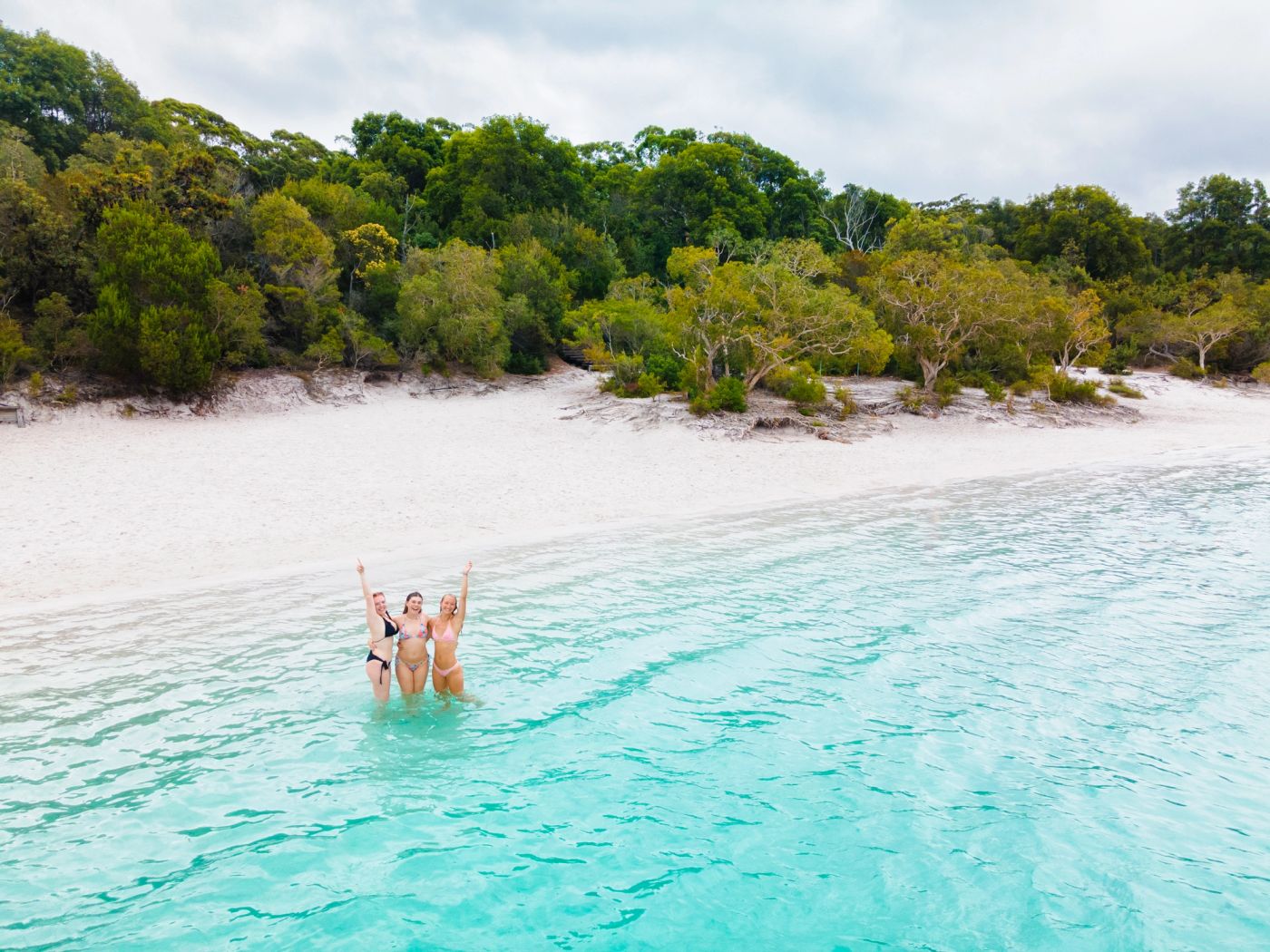
K’gari (Fraser Island) is the world’s largest sand island, and driving it is beach driving: soft sand, tide tables, 75 Mile Beach as the main road. Many rental companies do not allow campervans or roof-top tent vehicles on sand at all, and some exclude K’gari by name. Check your rental terms, but assume no.
The fix is a vehicle built for the island. Our K’gari 4WD hire is a lifted automatic 4WD with recovery gear, barge transfer and audio guide included, for three, four or five days, priced per vehicle with up to five sharing. You sort your own vehicle access permit, food and fuel. Do the island on that and keep the campervan for the mainland.
Good to know
- Corrugations. Slow down until the rattling drops to a hum. Let the tyres down a little for gravel (use the numbers on the rental handover sheet, not the internet’s) and pump them back up for bitumen. Walk around the rig at every stop and tighten what has loosened.
- Dust. It gets into everything. Sealed containers for food, bags for cameras, and accept that your clothes are now a slightly different colour.
- Water and fuel. Carry more water than you think, for you and the radiator. Fill the tank at every roadhouse, even at half full; the next one may be shut.
- Daylight. Drive in daylight. Wildlife on the road at dusk is the main hazard out there, and it is not a small one.
- Communications. Coverage disappears fast off the highway. Tell someone your route, and consider a satellite messenger for the Gibb and the Cape.
- Rental terms. Read where the vehicle is and is not allowed to go. Most companies list permitted tracks and exclusions, and that list decides your route more than any guidebook will.
FAQs
How much is 4WD camper hire in Australia?
A roof-top tent 4WD starts from $119 a day and a 4WD campervan with the bed and kitchen inside from $159 a day. Fuel, one-way fees, camping fees and dry-season demand in the north add to that, so get a free quote for your dates and depots to see the real total.
Can I drive a 2WD campervan on unsealed roads?
Usually not. Many rental companies restrict 2WD vehicles to sealed roads and may void cover on gravel. Check your rental terms. If a route you care about is unsealed, hire the 4WD.
Is a 4WD worth it for Uluru and the Red Centre?
Not for Uluru, Kings Canyon or the Stuart Highway, which are sealed. It becomes worth it for the Mereenie Loop and the unsealed tracks around the West MacDonnells.
Do 4WD campers include unlimited kilometres?
The 4WD camper we quote lists unlimited kilometres with outback driving permitted; the roof-top tent lists unlimited kilometres with most operators. Confirm it on your quote, because this term varies.
Can I take a rental 4WD campervan to K’gari?
Many rental companies prohibit beach and sand driving, so in most cases no. Use a dedicated K’gari 4WD hire instead.
When can I drive the Gibb River Road?
The dry season. In the wet season, roughly November to April, many unsealed roads close, and the Gibb is normally one of them.
Ready for a real number? The free campervan quote prices your dates, depot and drop-off, one-way fees included, so you can see what the 4WD actually costs against a 2WD before you decide.
Tagged