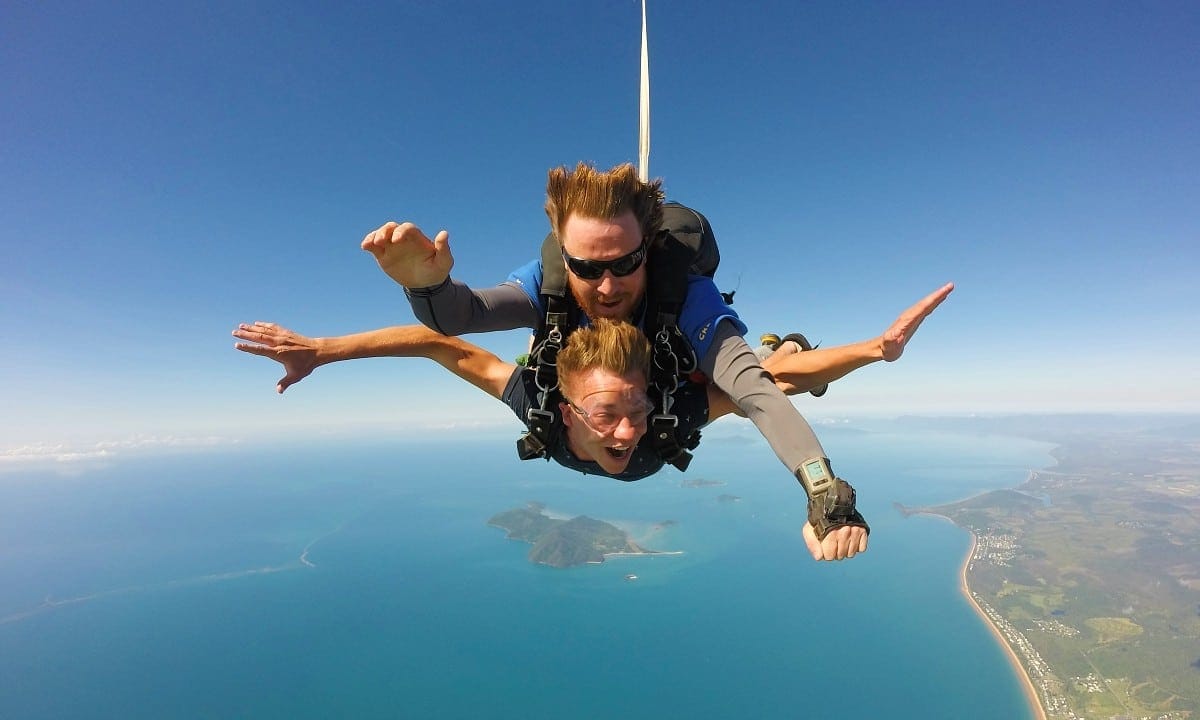
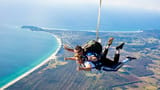
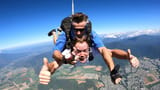
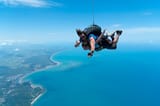

Réponse courte : the minimum age for a tandem skydive in Australia is 16, and anyone under 18 needs a parent or guardian at the drop zone to sign the forms. You need no experience: you are clipped to a professional tandem instructor who does the technical work. Most drop zones have a maximum weight of about 110 to 115 kg, with surcharges from 94 kg at some operators. Tandem jumps include a reserve parachute and an automatic activation device. A jump takes a few hours door to door, though freefall is only about 30 to 60 seconds.
Facts below were checked on 27 October 2026 against the Australian Parachute Federation (APF), the national sport body that regulates skydiving, and the published FAQ of Skydive Australia, plus the listings of the operators we sell. Rules differ slightly by operator, so confirm yours at booking.
Questions: who can jump
How old do you have to be to skydive in Australia?
You must be 16 to do a tandem skydive. Skydive Australia states the 16-year minimum is set by law. If you are under 18, a parent or legal guardian has to be at the drop zone on the day to complete and sign the check-in and consent forms, so consent by text or email is not enough.
Is there a weight limit for skydiving?
Yes, and it varies by drop zone. Skydive Australia says everyone is weighed at check-in, surcharges apply at 94 kg including clothing and shoes, and at most of its drop zones the maximum is 110 to 115 kg. Heavier jumpers may be able to go depending on which qualified instructors are available. Our Rottnest Island listing states a 95 kg limit, with up to 110 to 115 kg at the instructor’s discretion. If you are near or over 95 kg, ask the operator before booking.
Can you skydive with no experience?
Yes. A tandem skydive needs no experience at all. You are harnessed to a professional tandem instructor who handles the freefall, the parachute and the landing. Your job is to follow instructions on exit and landing and, in freefall, to enjoy it.
Can you skydive solo?
Yes, through an accelerated freefall (AFF) course, but not on day one. Skydive Australia’s AFF course has 9 stages, normally 7 to 10 jumps, and two days of ground training before the first jump. You can do a maximum of 3 jumps a day, so the fastest it can be done is about 5 days, and they suggest allowing two to three weeks. You must be 18, or 16 with parental consent. Most backpackers do a tandem; the AFF course suits people staying a while.
Can you skydive if you are pregnant, have epilepsy or have a heart condition?
Not if you are pregnant: Skydive Australia does not allow anyone who is pregnant to skydive. For epilepsy and heart conditions, they ask you to tell them in advance, as it may mean you cannot jump. Other conditions, such as a previously dislocated shoulder, can be possible with the right body position. Tell the operator about any medical condition when you book, not at the drop zone.
Can you skydive after scuba diving?
Not within 24 hours. Skydive Australia says you must not have been scuba diving in the 24 hours before a skydive, because of the change in altitude and pressure. If you are combining a Great Barrier Reef dive trip with a Cairns or Mission Beach jump, do the skydive first, or leave at least 24 hours after your last dive.
Questions: safety
Is skydiving safe in Australia?
Tandem skydiving in Australia is regulated by the APF, which sets the rules for equipment, instructors and training. APF rules require tandem jumps to use approved equipment, and every tandem rig must carry a working automatic activation device (AAD). We have not quoted injury or fatality statistics because we could not verify a current national figure; ask the operator for their safety record if it matters to you.
Do skydivers have a backup parachute?
Yes. Every tandem rig has a main parachute and a reserve. Skydive Australia explains that on the rare occasion the main does not open properly, your instructor releases it and pulls the reserve. The APF also requires an AAD set to activate at 4,000 ft on tandems, which deploys the reserve automatically if the parachute has not been opened by then.
Que se passe-t-il si la météo est mauvaise ?
The jump is cancelled and rescheduled. Skydive Australia says heavy rain, strong wind and low thick cloud will cancel a jump, while partly cloudy conditions or light showers do not. Beach landings are weather-dependent too: our Airlie Beach listing says the beach landing happens when conditions allow, and Mission Beach says weather permitting. Do not book a jump for the day you fly out.
How long does a tandem skydive take?
Plan on a few hours, and possibly the whole day. Skydive Australia says the whole experience takes a few hours and can be a full-day activity when weather delays things. Freefall itself is short: the operator listings on our site give about 30 seconds from 10,000 ft and up to 60 seconds from 14,000 to 15,000 ft. The canopy ride after the parachute opens (about 4,000 ft) adds 5 to 7 minutes on the listings that state it.
Questions: height, place and gear
What is the difference between a 10,000 ft and a 15,000 ft skydive?
Altitude buys freefall time. On the listings we sell, 10,000 ft gives about 30 seconds of freefall and 14,000 to 15,000 ft gives up to 60 seconds. In Australia the full-height jump is often not much dearer than the low one, so most people choose 15,000 ft. Prices by height are in combien coûte un saut en parachute en Australie.
What is the best place to skydive in Australia?
It depends on what you want to land on and look at. On our listings, Mission Beach has a 15,000 ft jump with a beach landing (weather permitting), Byron Bay has up to 60 seconds of freefall over Cape Byron, Airlie Beach lands on Midge Point Beach, and Wollongong et le Great Ocean Road offer beach skydives. Our East Coast skydive guide compares them.
What should you wear for a skydive?
Loose, comfortable clothing such as activewear, jeans or tracksuit pants, with fully enclosed shoes like runners or sports trainers. Skydive Australia says to avoid hiking boots and high heels, and to bring gloves and warm layers in colder months. Goggles are provided and fit over prescription glasses and contact lenses.
Can you get photos and video of your skydive?
Usually yes, as a paid extra. On the listings we sell, video and photos are not included in the jump price and are bought on the day. Skydive Australia says personal cameras are prohibited unless the jumper has done 200 or more skydives, so the operator’s own photo and video packages are the route. Budget for it when you plan.
Questions: cost
How much does skydiving cost in Australia?
Tandem skydives on our site run from 209 € upwards, depending on place, height and whether transfers and a beach landing are included. Every jump in one list is on our skydiving prices page.
Combien coûte un saut en parachute à Byron Bay ?
Dès 249 € pour le Saut en parachute en tandem à Byron Bay à 15 000 ft (avec transfert Byron Bay). It includes return transfers from your Byron accommodation, three months of APF membership, compulsory personal accident insurance and a certificate. Photos and video are extra.
How much is a skydive in Cairns?
Dès 229 € pour le Saut en parachute en tandem à Cairns jusqu'à 15 000 ft avec transferts, with free return pick-ups from Cairns and surrounds. A lower option, the Saut en parachute en tandem à Cairns jusqu'à 14 000 ft, is from 209 €.
How much is a skydive in Airlie Beach?
Dès 229 € pour le Saut en parachute en tandem avec atterrissage sur la plage from Airlie Beach. It includes free Airlie Beach transfers, up to 60 seconds of freefall and a 5 to 7 minute canopy ride over the Whitsunday Islands, landing on Midge Point Beach when conditions allow.
New Zealand has skydives too; the prices are compared at the end of our Australia skydive cost guide.
Book it
See every jump and what is included on skydiving prices. Popular picks are Mission Beach dès 249 €, Cairns dès 229 € et Byron Bay dès 249 €.
Tags