

Réponse courte : you land at Nadi International Airport, spend your first night in Nadi or Denarau, and catch the island catamaran from Port Denarau (about 20 minutes away) at 8.45am the next morning. Before you board, get Fijian dollars at the airport: there are no banks on the islands, and you’ll pay a compulsory meal plan at each island resort (FJ$135 to FJ$209 a day) plus a ferry fuel surcharge (currently FJ$20). Fiji uses the same plugs as Australia and New Zealand. Say “bula” (hello) and “vinaka” (thank you), and cover your shoulders and knees in villages.
Landing in Nadi
- Visitor permit. Citizens of visa-exempt countries, including Australia, New Zealand, the UK, the US, Canada and many European countries, get a visitor permit of up to four months on arrival. Check your own passport on Fiji Immigration’s list before you book.
- Passport and onward ticket. Your passport must be valid for at least six months from the day you arrive, and you need a return or onward ticket. Have your first night’s booking handy.
- Arrival card. You fill it in on the plane or at the airport.
- Cash. The arrivals hall has 24-hour currency exchange and there are ATMs. Get your Fijian dollars here (more on money below).
The island boat leaves early, so almost everyone spends the first night on the mainland. Our Fiji Welcome Pack, Smugglers Cove, dès 49 €, sorts that night in one booking: a rep meets you in the arrivals hall, a shared transfer takes you to Smugglers Cove on Wailoaloa Beach, and next morning a coach runs you to Port Denarau for your boat. There are also welcome packs at Club Fiji Resort, Aquarius on the Beach et The Palms Denarau.
Port Denarau and the Yasawa Flyer
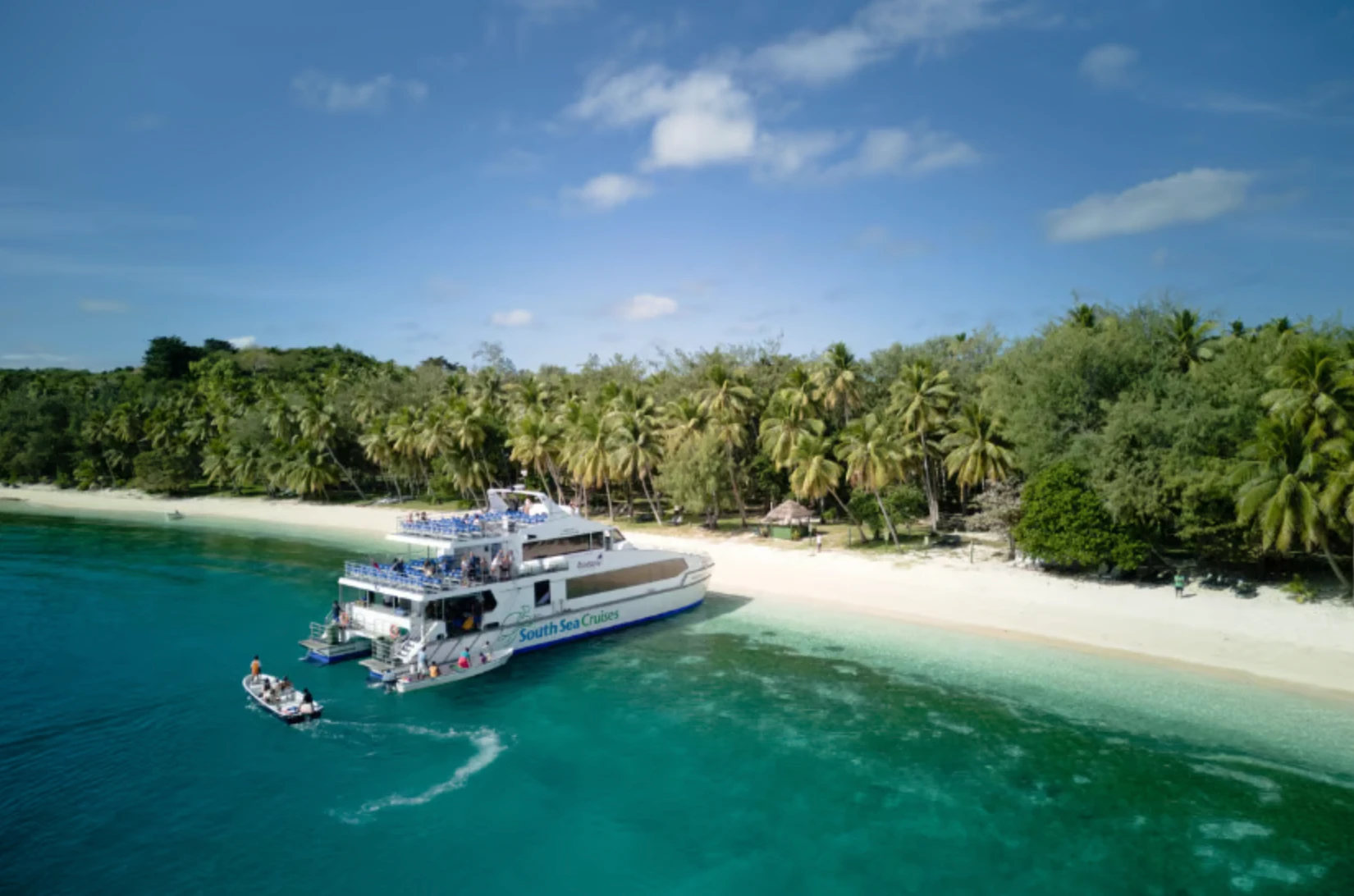
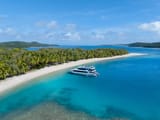
Every island hop on our passes and packages uses the same boat: the Yasawa Flyer, a high-speed catamaran.
- Coach to the marina. A coach collects you from most Nadi, Denarau, Vuda and Wailoaloa hotels and drops you at Port Denarau. It’s included in the passes and packages.
- Check in early. Be at the terminal at least 30 minutes before departure. Pay the ferry fuel surcharge (currently FJ$20 per person, set monthly) at check-in if you haven’t paid it online.
- The Flyer leaves at 8.45am, every day. It runs out through the Mamanuca Islands and up the Yasawa chain, then turns around and is back at Port Denarau in the early evening.
- Resort boats meet it offshore. Small boats come out to the Flyer and carry you and your bag to the beach. Expect wet feet and keep your phone in a dry bag.
- Book each move a day ahead. To change islands, book your next leg and bed at least 24 hours before, through us or the travel desk on board.
Which ticket to buy is its own question. The short version: the Bula Pass is the boat only, the Yasawa Pass is the boat plus a bed every night, and a set package fixes the route and adds activities. The full breakdown is in Bula Pass vs Yasawa Pass vs a package.
Money: get cash before you board
- Currency. Fiji uses the Fijian dollar (FJD). Prices on the islands are in FJD.
- ATMs. Use the ones at Nadi airport or Port Denarau. There are no banks on the islands and most have no ATM. Tourism Fiji notes a daily ATM withdrawal limit of FJ$2,000.
- Cards. Resorts usually take cards for meal plans and activities, sometimes with a surcharge. Keep cash for drinks, village visits and small extras.
- Tipping isn’t expected in Fiji.
Meal plans are paid at the resorts
This is the cost that surprises first-timers. Most Yasawa islands have few or no shops or cafes, so each resort sells a daily meal plan and makes it compulsory. You pay it at the resort, on top of your bed. Published rates at the backpacker resorts on the Flyer’s route run from FJ$135 to FJ$209 per person per day (for travel to 31 March 2027). Over a week, that’s often more than the boat pass.
The resort-by-resort rates are in our Bula Pass prices guide. Two of our trips include island meals: the Seabreeze Island Hop, dès 1 389 €, covers all meals on its three islands, and the Kuata shark snorkel overnight, dès 229 €, includes resort meals for your night.
Vegetarian, vegan or another dietary need? Tell us when you book and we pass it on to every resort.
The FJ$20 fuel surcharge
The ferry operator adds a fuel surcharge per person, paid at check-in or online before you travel. It’s set each month and was FJ$20 in October 2026. It isn’t in any pass or package price, ours included, so budget for it in Fijian dollars.
Sundays
Sunday is church day in Fiji and a rest day in the villages. Village visits don’t usually run on Sundays, and the Sawa-i-Lau caves near the Blue Lagoon don’t open on Sundays. Resorts, beaches and reefs are all there as usual, so treat it as your slow day. If you’re invited to a church service, go, dressed as you would for a village visit.
Water and power
- Drinking water. Tourism Fiji says tap water in Nadi, Suva and the big resorts is treated, but most resorts still advise guests not to drink it. On the outer islands, water often comes from springs, rain tanks or bores. Drink bottled or filtered water and bring a refillable bottle.
- Power. 240 volts, with the same three-pin plugs as Australia and New Zealand. Power can be limited on small islands, so bring a power bank.
Quoi mettre dans ton sac
- Swimmers (two pairs: nothing dries overnight)
- Reef-safe sunscreen, hat and sunglasses
- Rash vest for snorkelling
- Dry bag for the resort boat transfers
- Reef shoes or sandals that can get wet
- A soft 40 to 60 litre bag and a small daypack (easier than a hard case on the small resort boats)
- A sarong or light layer that covers shoulders and knees, for villages
- Anti-insectes et petite trousse de premiers secours
- Head torch (island paths are dark at night)
- Power bank
- A light jumper for the boat and cool dry-season evenings
- Fijian cash
Bula, vinaka and village etiquette
- Bula means hello. It’s a wish for life and good health, and you’ll hear it all day.
- Vinaka means thank you.
- Cover up in villages. Shoulders and knees covered. Wrap a sulu (sarong) around your waist as you walk in; it comes off again when you leave. The Yasawa Wanderer et Seabreeze Island Hop include a sulu.
- Hats and sunglasses off in a village, as a sign of respect for the chief. Carry your bag in your hands rather than on your shoulder.
- Don’t touch anyone’s head. In many villages it’s considered sacred.
- Sevusevu. Visitors present a small bundle of kava to the chief to ask permission to enter. Your guide handles the details; follow their lead on where to sit.
- Kava. You’ll be offered a coconut shell of it at village ceremonies and resort kava circles. Clap once, drink it in one go, then clap three times.
Village visits are included on Fidji : 7 jours, 4 îles et le 12-Day Island Explorer, et le Fiji Beach & Culture Tour starts with a sevusevu on the way to Robinson Crusoe Island.
The last night
The boat gets back to Port Denarau in the early evening, too late for most flights home. Book a mainland night before you fly. Our departure packs (Smugglers Cove dès 49 €, Club Fiji Resort dès 59 €) cover the coach from Port Denarau, the night and a shared transfer to Nadi International Airport.
The easiest first trip of all is the Fiji, escapade de 7 jours sur les îles, dès 489 €: a Nadi night at each end, airport transfers, the boat and four island nights in one booking.
Where next
- When to go: Best time to visit Fiji
- How long to stay: Fiji itineraries for 5, 7, 10 and 14 days
- Which trip: Fiji island-hopping packages compared et Best Fiji island hopping trips for backpackers
- The islands themselves: our guide de voyage aux Fidji
FAQ
How do I get from Nadi airport to the islands?
Spend your first night in Nadi or Denarau, then take the coach to Port Denarau (about 20 minutes from the airport) for the 8.45am island catamaran. Our welcome packs cover the airport pickup, the first night and the coach to the boat.
Do I need cash in Fiji?
Yes. There are no banks on the islands and most have no ATM. Get Fijian dollars at Nadi airport or Port Denarau. Resorts usually take cards for meal plans, sometimes with a surcharge, but you’ll want cash for drinks, village visits and extras.
Les repas sont-ils inclus dans les voyages aux îles Fidji ?
Usually not. Most island resorts charge a compulsory daily meal plan of FJ$135 to FJ$209 per person, paid at the resort. The Seabreeze Island Hop and the Kuata shark snorkel overnight are exceptions with island meals included.
What is the Fiji ferry fuel surcharge?
A per-person surcharge the ferry operator sets each month, paid at check-in or online. It was FJ$20 in October 2026 and isn’t included in any pass or package price.
Can you drink the tap water in Fiji?
Tourism Fiji says tap water in Nadi, Suva and big resorts is treated, but most resorts advise guests not to drink it. On the outer islands, stick to bottled or filtered water.
What plugs does Fiji use?
The same three-pin plugs as Australia and New Zealand, at 240 volts. Visitors from elsewhere need an adaptor.
What should I wear to a Fijian village?
Cover your shoulders and knees, with a sulu (sarong) around your waist. Take off your hat and sunglasses, and carry your bag in your hands.
What does bula mean?
Hello. It’s a wish for life and good health. “Vinaka” means thank you.
Plan your Fiji trip
Tell us your dates and how you like to travel, and we’ll put your Nadi nights, the boat, the islands and your beds together as one package price. It’s free, there’s no obligation, and your personalised quote comes within hours: plan your Fiji trip.
Bundle your Fiji trip and save up to 8%. On trips that combine 2 or more parts (5% for 2, up to 8% for 3+), quoted in one package price.
Want all of this on paper? Our free Island Hopping Fiji guide has the packing list, money tips and arrival basics as a page or a printable PDF.
Tags


