
Réponse courte : from Cairns, the outer Great Barrier Reef is a boat ride of roughly 90 minutes to two hours, and the reef is alive and worth visiting: the Australian Institute of Marine Science (AIMS) reported in August 2026 that hard coral cover rose in the northern and central regions after the 2024 bleaching, and sits close to its 40-year average. You do not need to swim to see it, because pontoons, semi-submersibles, glass-bottom boats and scenic flights all work, and you can try scuba without a licence on an introductory dive. The best months are June to October, a day trip is roughly nine hours, and the main extra on top of the ticket is the Great Barrier Reef Marine Park Authority (GBRMPA) environmental management charge.
Facts below were checked on 27 October 2026 against AIMS, GBRMPA, Queensland Health and operator websites, linked in the text. Boat times, minimum ages and add-on charges vary by operator, so confirm on the tour page before you book.
Questions: getting there and what to expect
How far is the Great Barrier Reef from Cairns?
The outer reef is roughly 90 minutes to two hours by boat from Cairns, depending on the boat and the site. The reef is not one spot: it stretches about 2,300 km along the Queensland coast, so “the reef” from Cairns means one of a few places. The inner reef and islands such as Green Island and Fitzroy Island are closer, about 45 minutes by ferry. The outer reef is further offshore, where the water is clearer and the coral healthier. Our day trip comparison lists the boats and sites side by side.
Is the inner reef or the outer reef better?
The outer reef is better for most people. It sits near the edge of the continental shelf, away from river run-off, so visibility is usually higher and the coral and fish life are more varied. Inner reef and island trips are cheaper and shorter, and suit a half day or anyone who gets seasick. For a first trip, pick an outer reef boat such as the Excursion d'une journée sur le récif externe de la Grande Barrière de corail, dès 179 €.
How long is a Great Barrier Reef day trip?
A full-day reef trip from Cairns runs about eight to nine hours from check-in to return, including the boat ride out and back. Time on the reef varies too: the Evolution Outer Reef Cruise gives you about five hours at the outer reef, and Port Douglas has half-day trips to Low Isles. Check the departure and return times on the tour page, because they differ by operator.
Can you see the Great Barrier Reef without snorkelling?
Yes. You can see it from a pontoon with a semi-submersible or glass-bottom boat ride, from the air on a scenic flight, or by staying dry on a viewing platform. Pontoon days such as Journée snorkeling sur ponton au récif externe au départ de Cairns, dès 209 €, moor at a fixed platform on the outer reef with an underwater viewing option. From the air, the Cairns Reef Hopper : vol panoramique coûte dès 189 €.
Can you visit the Great Barrier Reef if you can’t swim?
Yes. Pontoon platforms, semi-submersibles, glass-bottom boats and scenic flights keep you out of the water or in the shallows with a flotation device. Reef operators supply flotation such as vests and noodles. Tell the crew at check-in that you are a weak or non-swimmer and they will brief you on the safest option.
Can you fly over the Great Barrier Reef?
Yes. Scenic flights run from Cairns and from the Whitsundays by helicopter and seaplane. The reef looks different from above, with the shapes of the coral platforms, cays and channels visible in a way they are not from the water. The Cairns Reef Hopper : vol panoramique coûte dès 189 €. For the Whitsundays, the 60 Min Scenic Flight, Whitehaven and Heart Reef coûte dès 219 €.
Questions: the state of the reef
Is the Great Barrier Reef dying?
No, but it has been hit hard by repeated bleaching and it is still recovering. AIMS’s annual long-term monitoring report, released on 11 August 2026, found hard coral cover of 35.1% in the northern region and 31.6% in the central region, both up from the year before, and 26.4% in the south, down slightly. AIMS says cover remains close to its 40-year average and describes early signs of recovery from the 2024 mass bleaching, while warning that bleaching, floods, cyclones and crown-of-thorns starfish remain pressures. Source: AIMS Great Barrier Reef condition summary 2025-26.
Is it still worth visiting the Great Barrier Reef?
Yes. The reef is about 2,300 km long and conditions differ site to site, so a healthy outer reef site is the norm on the day boats rather than the exception. AIMS data show recovery is under way in the north and central regions where Cairns and Port Douglas boats operate. Pick an outer reef trip, go in the dry season if you can, and ask the operator which sites it visits.
Questions: swimming, snorkelling and diving
What is the difference between snorkelling and diving on the reef?
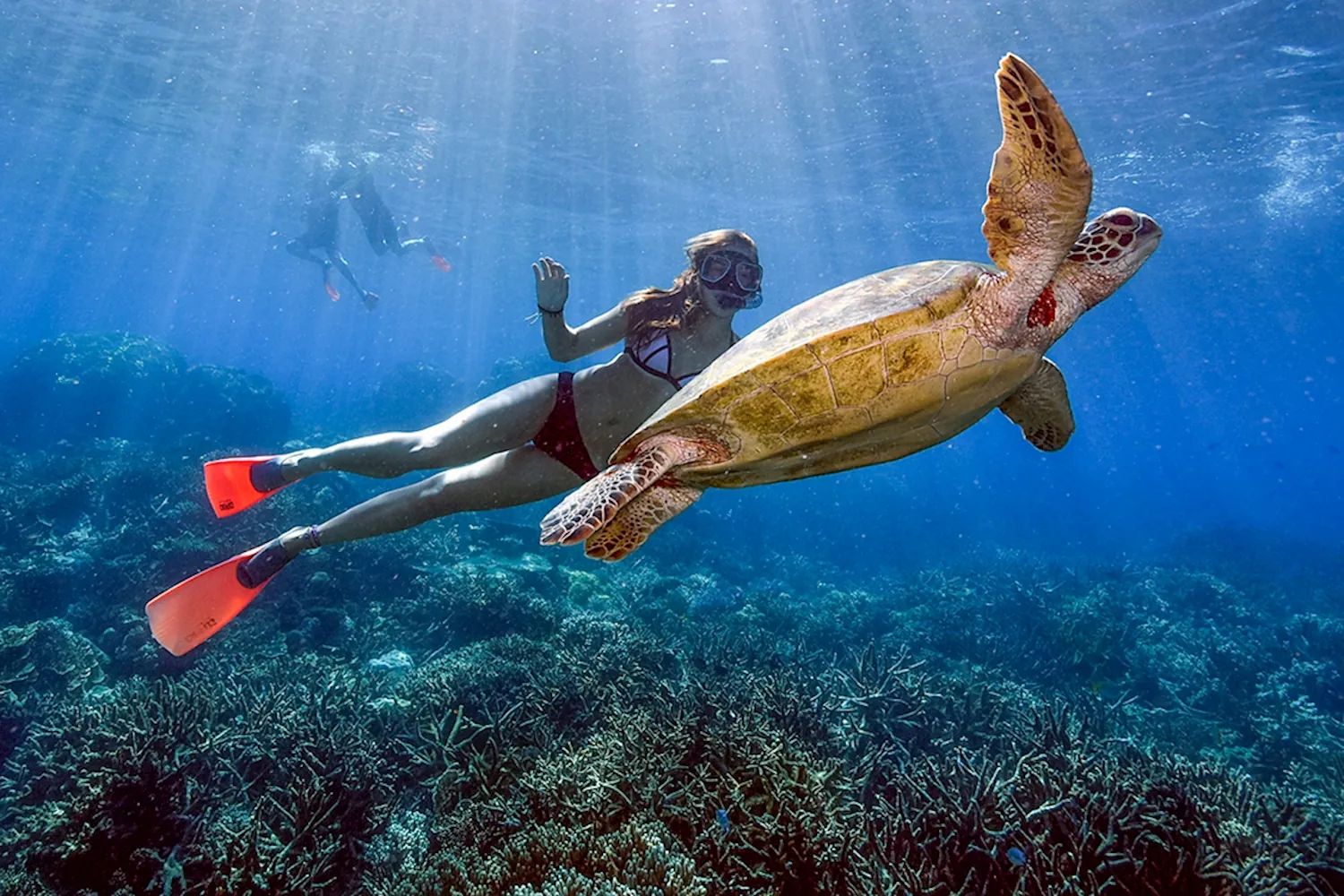
Snorkelling is floating on the surface with a mask, snorkel and fins, looking down at the reef. Diving means breathing from a tank and swimming underwater with an instructor or guide. Snorkelling needs no training and is included on almost every day trip. Diving adds equipment, a medical questionnaire and an extra cost, but lets you get down among the coral and fish. Most day boats offer both on the same trip.
Can you scuba dive on the Great Barrier Reef without a licence?
Yes. An introductory dive (also called a resort dive or discover scuba dive) lets you dive with an instructor and no certification, usually to around 10 to 12 metres. You complete a medical questionnaire, a short briefing and a few skills in shallow water, then dive holding the instructor’s hand or equipment. The Excursion à la journée tout compris sur le récif externe au départ de Cairns, dès 179 €, includes one introductory dive, medical permitting.
Is there an age limit for snorkelling or diving on the reef?
Yes, and it varies by operator. Cairns snorkelling trips set minimum ages from about 4 to 12 depending on the boat, introductory dives are commonly 12 and over on day boats, and PADI’s Discover Scuba Diving program is open from age 10. Operators set their own rules for children, so check the tour page before you book.
What is the dive medical questionnaire?
It is a standard form asking about conditions such as asthma, heart problems, ear and sinus trouble, recent surgery and some medications. If every answer is no, you sign and dive. If anything is flagged you need a doctor’s sign-off before the operator lets you in the water. Sort it before you arrive: our guide pour apprendre à plonger explains how it works in practice.
Can you snorkel from the shore on the Great Barrier Reef?
Only at a few islands, not from the mainland beaches. Cairns and Port Douglas beaches have no reef to speak of, and swimming from open beaches carries crocodile and stinger risk. Islands such as Green Island and Fitzroy Island have coral you can reach from the beach, and a reef boat is the reliable way to reach healthy coral. See our snorkel, dive and liveaboard guide for island and outer reef options.
What should you wear snorkelling on the Great Barrier Reef?
Wear swimmers and a stinger suit if the boat supplies one, which is standard in stinger season. A rash vest or the supplied lycra suit also protects you from sunburn. Bring reef-safe sunscreen, a towel, a change of clothes and a seasickness tablet taken before you board. Masks, snorkels, fins and suits are provided on most day trips.
Questions: when to go and how safe it is
What is the best time to snorkel the Great Barrier Reef?
June to October is the best time. It is the dry season, with calmer seas, lower humidity, less rain and generally clearer water. December to February is hotter and wetter, the water is warm, and coastal visibility drops after heavy rain, though the outer reef is less affected. Our summer reef guide covers what changes and what to book.
Is there a stinger season on the Great Barrier Reef?
Yes. Queensland’s marine stinger season typically runs from November to the end of May, and it can start earlier or finish later. Box jellyfish and Irukandji are the species that matter in tropical waters. Reef boats supply full-body stinger suits in the season and you wear one for every swim. Source: Queensland Government statement on marine stingers.
Is the Great Barrier Reef safe for snorkelling?
Yes, on a guided boat trip where the crew brief you and watch the water. The main risks are sunburn, seasickness, strong currents on some sites and marine stingers in season, and the crew brief you on each. Stay in the marked snorkel area, wear the stinger suit when it is issued, and tell the crew about any medical conditions.
Questions: cost and choosing where to go
How much does a Great Barrier Reef trip cost?
Outer reef day trips from Cairns start low and climb for pontoon days and Port Douglas outer reef trips. Cheapest of the three main boats: the Full Day Outer Reef Tour and Evolution Outer Reef Cruise, both 179 €. Scuba, lunch upgrades and some fuel charges can be extra, so read what each trip includes. See live prices on the Great Barrier Reef tour prices page and our cost breakdown.
What is the reef levy or environmental management charge?
It is a charge paid per person per day to GBRMPA to fund reef management, and operators either include it in the ticket or add it on. GBRMPA’s rate is 5,37 € for a full-day passenger and 2,69 € for a part-day passenger from 1 April 2026, rising to 5,68 € and 2,84 € from 1 April 2027 (checked Oct 2026). Some trips list a separate fuel surcharge as well. Source: GBRMPA environmental management charge.
Cairns, Port Douglas or Airlie Beach for the reef?
Cairns has the most boats, hostels and the lowest prices, so it suits most backpackers. Port Douglas is quieter and about an hour north, with boats to the Agincourt Reef and Low Isles: the Agincourt Reef : journée snorkeling sur ponton au départ de Port Douglas coûte dès 209 €. Airlie Beach is the base for the Whitsundays and Heart Reef, mixing sailing with reef. Our three-town comparison goes into detail.
Is a liveaboard worth it?
Yes, if diving is the reason you are going. A liveaboard sleeps you on the boat, reaches remote outer reef sites with far fewer day boats, and lets you dive at dawn and dusk. The Cod Hole and Ribbon Reef 3 Night Liveaboard coûte dès 1 519 €. For a first look at the reef, a day trip is better value; a liveaboard suits certified divers or people learning to dive. See the guide pour apprendre à plonger if you want to be certified on the reef.
Book it
Compare outer reef boats, pontoons and dive trips on the Great Barrier Reef tour prices page, or the Port Douglas reef tour prices page if you are basing north. Good starting points are the Excursion d'une journée sur le récif externe de la Grande Barrière de corail dès 179 € et le All-Inclusive Outer Reef Day Trip dès 179 €. More on the area at the Great Barrier Reef hub.
Tags